

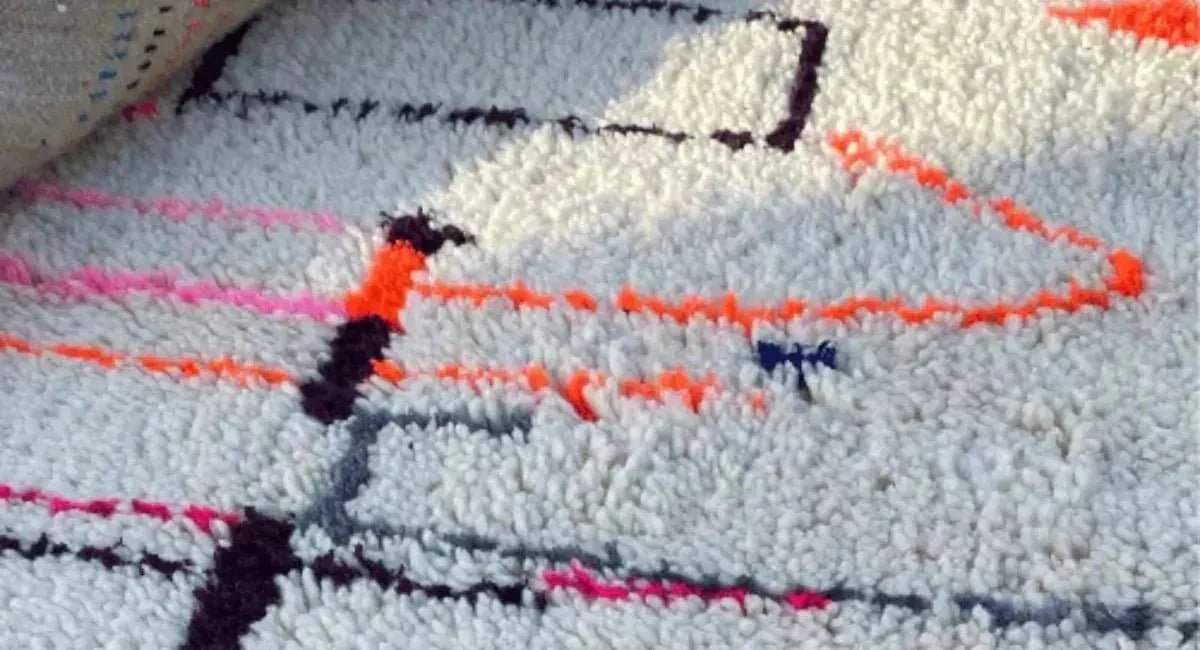

An authentic Berber rug is distinguished by its thick texture, imperfect patterns, and handmade weave. Every detail carries the unique signature of an artisan from the High Atlas. Here is a simple yet sensitive guide to ensure you don't make the wrong choice.

Memory. The first rug I ever touched felt warm, almost alive. The wool clung to my fingers a little, as if each fiber held the memory of the weaver's touch. A real, authentic Berber rug is felt before it is "verified."
This guide is not a cold checklist: we mix materials, sensations, little tricks, and a love for handmade work. Follow the thread.
1. The material: virgin wool, dense and warm
The key is natural wool. Dense and insulating, it captures light without having a "plastic" shine. Gently rub two fibers together: warmth builds up, and a subtle scent of damp wood emerges. Synthetic fibers remain silent.
- Touch: firm softness, no smooth slipping.
- Look: soft reflections, no shiny uniformity.
- Smell: natural notes (never chemical).
2. The handmade weave: the irregularities that reassure
Machines love regularity. Artisans, however, compose. A tighter knot, a hesitating line: these are all signs of a handmade Berber rug.
Under the rug
Turn it over. You will see the weft, individual knots, and a density that varies slightly. This is normal and reassuring.
Regional signatures
- Beni Ouarain: ivory, thick wool, sober graphics.
- Azilal: spontaneous colors, free-form motifs.
- Zanafi: black & white, highly graphic flat weave.
- Boujad: warm tones, expressive compositions.
3. Patterns and symbols: telling stories without words
Protective diamonds, the broken lines of a journey, cross-hatching passed down like a song. A real, authentic Berber rug never copies mechanically: it interprets. Slight asymmetry, variation in thickness, the breathing of the design.
"Human perfection? An accepted imperfection."
4. Vegetable dyes: a living rainbow
Soothing indigo, henna red, deep pomegranate, solar saffron... Vegetable dyes develop a graceful patina over time. Conversely, industrial copies display overly flat, harsh colors that fade quickly.
5. Finishes: borders and (slightly) unruly fringes
The borders are not drawn with a school ruler: they have life, like the sometimes uneven fringes, knotted freely. That is the charm of the handmade.
6. Weight & texture: body without rigidity
A real rug has "body" but remains flexible. It folds without cracking and unrolls without resistance. This quality comes from ancestral craftsmanship—tension and suppleness, thread by thread.
7. Origin and traceability: documented trust
Ask about the region, the cooperative, the technique, and if possible, the artisan's name. At Decoecoart, every piece comes with clear information. Authenticity requires transparency and fair trade.
To explore: Beni Ouarain rugs · Azilal Berber rugs · Zanafi rugs
8. Price: a reflection of time and labor
Sometimes weeks or months of work. An abnormally low price, "too perfect" patterns, or vague material descriptions are red flags. An artisanal rug is a durable, ethical investment, not a disposable "bargain."
9. Use your senses as guides
- Touch: warm, slightly oily, never scratchy.
- Smell: natural, never chemical.
- Sight: micro-variations, soft reflections, living thickness.
10. Caring for an authentic Berber rug (simple steps)
- Aerate weekly, brush in the direction of the pile.
- In case of stains: warm water + mild soap, blot (do not scrub in circles).
- Dry flat, away from direct heat.
- Once or twice a year: 1 hour of morning sun to revitalize the fibers.
These simple steps will prolong the life and beauty of your real, authentic Berber rug.
Common pitfalls to avoid
- Vague descriptions (material, origin, or technique not specified).
- Patterns that are too regular / colors that are too uniform.
- "Impossible" prices for handmade items.
- Lack of traceability and ethical commitment.
Conclusion
Recognizing a real, authentic Berber rug means knowing how to look and feel. The variations, the slight hesitations, the visible knots: these are all proof of life. More than just decor, an artisanal rug brings a story, a memory, and a softness that cannot be mass-produced.
At Decoecoart, we stand for fair creation: unique, handmade, traceable pieces designed to last in your home and through time.