

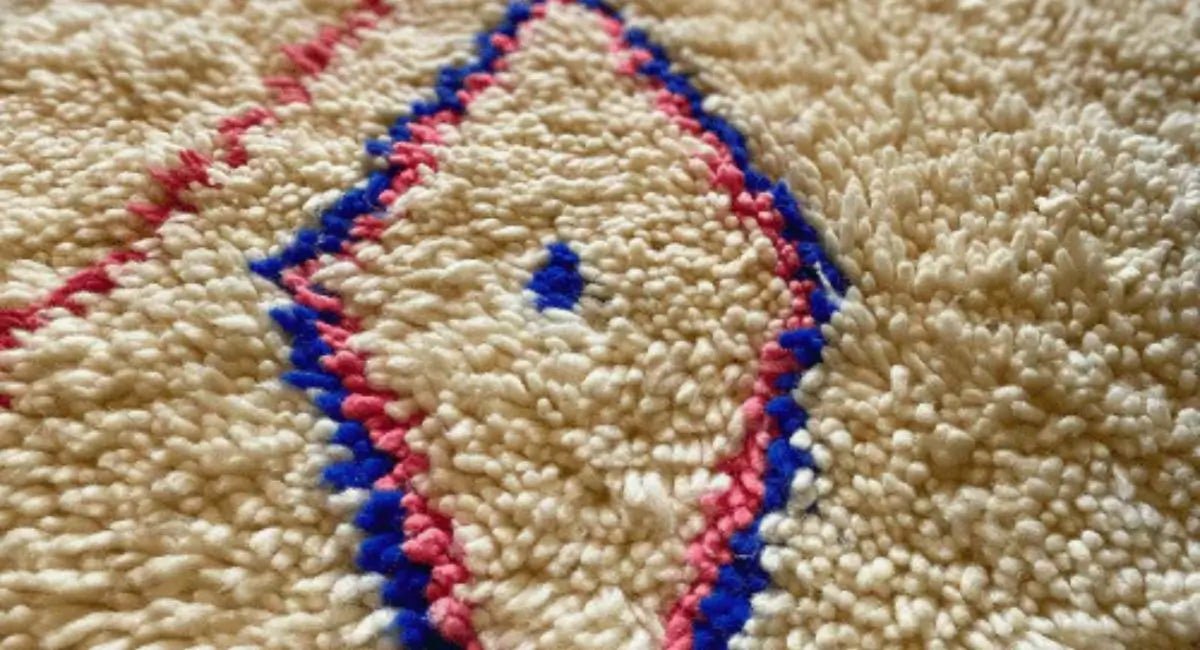
History of handcrafted Berber rugs
Moroccan authenticity is one of Morocco’s greatest sources of pride. Far more than a simple decorative object, they embody a living heritage, steeped in history, symbols, and emotions. Every handmade Berber rug tells a story: that of a woman weaver who, in the silence of her workshop, blends natural wool, geometric patterns, and the colors of her native land. Inherited from millennial traditions, these masterpieces of Moroccan authenticity now find their place in modern interiors all over the world, uniting design and heritage. Discover our collection of Berber rugs
1. The millenary origins of Berber weaving
The history of the handmade Berber rug dates back more than two thousand years. The Berber tribes of the High and Middle Atlas developed a unique art of weaving, passed down from mother to daughter. The rug was not just a household accessory: it served as a blanket, a mattress, protection against the cold, and a wedding dowry.
Each region—Beni Ouarain, Azilal, Boujad—possesses its own style, technique, and color palette. The wool used came from family herds, washed in spring water and spun by hand. It is this direct link between nature, family, and spirituality that gives artisan Berber rugs their unique soul.
2. The weaving technique: precision and patience
Weaving a Berber rug requires exceptional know-how.
On a vertical wooden loom, the weaver sets up the warp threads, then meticulously inserts the wool to create the weft. Every gesture is repeated thousands of times; a single rug can require several weeks, sometimes several months of work.
This intentional slowness is proof of quality: a handmade Berber rug is never identical to another. Its irregularities bear witness to the human touch, the spontaneity, and the artisanal character that make it a noble and durable product.
3. The patterns: an ancestral language
Berber symbols are much more than mere decorations. They form a true graphic alphabet, where each shape expresses a deep meaning:
-
The diamond: symbol of womanhood, fertility, and protection.
-
The broken line: represents the path of life, with its obstacles and joys.
-
The cross: a sign of faith and balance.
-
The triangle: evokes the family and the protective mountain.
These patterns, passed down orally for generations, constitute a universal language without writing. Each artisan Berber rug is therefore a narrative canvas, an intimate diary where weavers record their hopes, their prayers, and their memories.
4. Color: energy and identity
Artisan Berber rugs are also distinguished by their shades: natural ivory for the Beni Ouarain, vivid and contrasting tones for the Azilal, graphic black and white for the Zanafi.
The dyes, often of plant origin (poppy, henna, indigo, saffron, pomegranate), reflect a harmony between man and nature.
These colors are never chosen at random: they express the emotions, state of mind, or history of the weaver. A colorful handmade Berber rug thus becomes a reflection of an identity, a territory, and an artistic sensibility.
5. Women weavers: guardians of knowledge
At the heart of every artisan Berber rug, there is a woman. In the High Atlas mountains, weavers perpetuate an ancestral art, often within solidarity cooperatives.
Their know-how is not just technical: it is a carrier of memory. Each knot, each thread tells of the woman’s place in Berber society; mother, artist, and transmitter of culture. By purchasing a rug signed by Decoecoart, you directly support these women and participate in the preservation of a living, authentically Moroccan craft.
6. From the village to the contemporary interior
What makes the handmade Berber rug so fascinating is its ability to adapt. Once used in nomadic tents, it now commands attention in Parisian apartments or minimalist lofts.
The contrast between raw wool and clean design creates immediate visual warmth.
European interior designers acclaim it for its soft texture, its natural patina, and its soul.
An artisan Berber rug placed under a coffee table, at the foot of a bed, or in an office becomes the centerpiece that connects authenticity and modernity.
7. Spiritual and social symbolism
In Berber culture, the rug has always had a spiritual dimension. It serves as an offering, a talisman, and sometimes a silent prayer.
The patterns can ward off the evil eye, attract prosperity, or bless a union.
This is why many families keep their rugs as family heirlooms passed down from generation to generation.
Moroccan authenticity is not limited to the material: it is experienced through the deep meaning of the weaving, where each thread connects the visible to the invisible.
8. Ethics and sustainability at the heart of the Berber rug
At a time when responsible decoration is becoming essential, artisan Berber rugs stand out for their natural durability. They are made from pure wool, without chemical products or industrial production. Each piece is biodegradable, ethical, and directly supports the Moroccan rural economy.
Choosing a handmade Berber rug means investing in a durable object that is both aesthetic and carries human values.
9. How to recognize a true artisan Berber rug?
Before buying, you must know how to distinguish the authentic from the imitation:
-
Texture: soft but dense, 100% wool.
-
Patterns: asymmetrical, never perfectly identical.
-
Smell: light scent of natural wool.
-
Fringe: hand-knotted, irregular.
-
Certificate of origin: provided by the Decoecoart boutique, guaranteeing a handmade Moroccan product.
To explore our authentic models, find our authentic artisan Berber rugs
10. Why are Berber rugs still fascinating?
Because they tell the story of a people, a land, and a passion.
Because they connect generations and cultures, and because they are, above all, a reflection of the soul: a link between tradition and the future.
The artisan Berber rug is not just a decorative element; it is a living work, woven with love, memory, and identity. By integrating it into your home, you aren't just decorating your house—you are introducing a fragment of Moroccan authenticity and universal history.